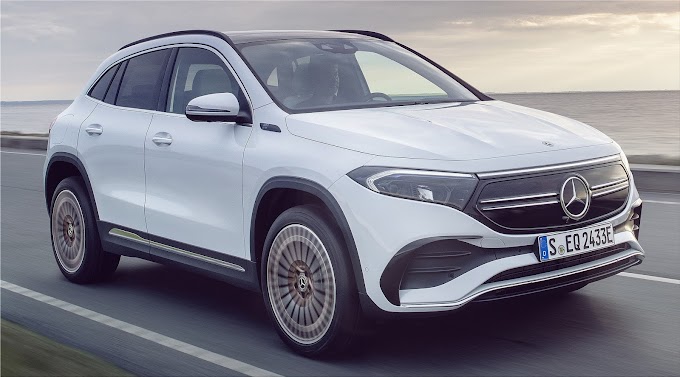
The next-generation Mercedes-Benz GLA abandons combustion engines completely. Mercedes-Benz engineers built this compact SUV on the dedicated electric MMA platform, and the result resets expectations for range, towing, and digital capability. The Swedish and Danish press offices just confirmed key figures: up to 650 km of WLTP range and a 2,000 kg trailer rating. Translate those numbers to the U.S. cycle, and you're looking at roughly 404 miles of range and 4,409 pounds of towing capacity. No other small electric luxury SUV offers that combination.
The Electric Foundation: 800-Volt Architecture and Battery Engineering
The new GLA rides on the Mercedes-Benz Modular Architecture (MMA), a ground-up electric platform with an 800-volt system. That choice cuts current, reduces heat, and enables flat charging curves that other 400-volt competitors cannot match.
The battery pack uses nickel-manganese-cobalt (NMC) chemistry with a usable energy content of 85 kWh. Cell-to-pack construction eliminates modules, increasing volumetric energy density by roughly 20 percent compared to the outgoing EQA. A two-stage cooling circuit with a heat pump and intelligent thermal preconditioning keeps the pack between 25 and 35 degrees Celsius during fast-charging sessions.
- Battery usable capacity: 85 kWh
- System voltage: 800 volts
- Max DC charging power: 320 kW
- 10-80% charge time: 20 minutes
- AC onboard charger: 11 kW (22 kW optional)
From an expert perspective, the 800-volt architecture functions as a range multiplier. You add 186 miles (300 km) of WLTP range in just 10 minutes at a 350-kW Hypercharger, making cross-country travel realistic without lengthy downtime.

Range and Efficiency: Why 404 Miles Changes the Segment
The rear-wheel-drive GLA 250+ with EQ technology posts the headline 650 km WLTP figure. Real-world highway range will settle closer to 350 miles at 70 mph, but that still outpaces everything in the class. The all-wheel-drive GLA 350 4MATIC sacrifices roughly 7 percent range due to the added front asynchronous motor and increased curb weight.
Mercedes lowered aerodynamic drag to 0.24 Cd by sealing the underbody, flattening the wheel designs, and optimizing the rear roof spoiler. Aero efficiency matters more at highway speeds than battery size alone.
| Model | WLTP Range | EPA-Estimated Range | Battery (Usable) | Towing Capacity |
|---|---|---|---|---|
| GLA 250+ | 650 km (404 mi) | ~360 mi | 85 kWh | 1,500 kg (3,307 lbs) |
| GLA 350 4MATIC | 600 km (373 mi) | ~335 mi | 85 kWh | 2,000 kg (4,409 lbs) |
| BMW iX1 xDrive30 | 440 km (273 mi) | ~280 mi | 64.7 kWh | 1,200 kg (2,645 lbs) |
| Audi Q4 40 e-tron | 520 km (323 mi) | ~265 mi | 77 kWh | 1,000 kg (2,204 lbs) |
Looking at the data, the GLA 350 4MATIC offers a 36 percent longer range than the BMW iX1 while towing 800 kg more. That gap stems from the dedicated 800-volt architecture and the larger, more energy-dense battery.
Towing Mastery: 2,000 kg of Capability
Few compact electric SUVs can legally pull a 2,000 kg braked trailer. The GLA 350 4MATIC achieves this through three engineering decisions. First, the rear electric drive unit uses a permanently excited synchronous motor (PSM) that produces 200 kW (272 hp) and 380 Nm of torque across a broad rpm band. Second, the body shell integrates cast aluminum shock towers and a magnesium front-end carrier to stiffen the structure without adding mass. Third, the battery pack acts as a structural floor member, raising torsional rigidity by 25 percent over the previous GLA.
An integrated trailer stability program modulates individual wheel brakes and motor regeneration when it detects sway. The hitch receiver mounts behind a removable fascia panel, preserving the clean rear design when not in use.
Pro-Tip: When towing near the 4,409-pound limit, pre-condition the battery using the departure timer while plugged in. Then select the ECO drive mode. That setting softens accelerator response and caps peak motor output, which smooths energy draw and extends real-world towing range by roughly 8 percent.
Dimensions and Packaging: Compact Exterior, Cabin Maximized
The new GLA's exterior grows subtly. At 4,417 mm long and 1,849 mm wide (without mirrors), it remains easy to park in European cities. The 2,729 mm wheelbase stretches 30 mm longer than the outgoing model, and that distance directly benefits rear legroom. Engineers lowered the beltline and raised the roof slightly at the rear to improve outward visibility and headroom.
- Length: 4,417 mm (173.9 in)
- Width: 1,849 mm (72.8 in)
- Height: 1,615 mm (63.6 in)
- Wheelbase: 2,729 mm (107.4 in)
- Cargo volume (seats up): 470 liters (16.6 cu ft)
- Cargo volume (seats folded): 1,320 liters (46.6 cu ft)
By comparison, the Volvo EX30 rides on a shorter 2,650 mm wheelbase and offers only 318 liters of cargo space. The Mercedes packaging team placed the HVAC unit under the hood instead of behind the dashboard, freeing the full width of the front footwell.
Digital Experience: MB.OS and the Superscreen
The cabin centers on the optional MBUX Superscreen, a single glass panel housing a 10.25-inch instrument cluster, a 14.4-inch central touchscreen, and a passenger display. The underlying Mercedes-Benz Operating System (MB.OS) separates sensor data, infotainment, and body control onto different compute domains. Consequently, over-the-air updates can upgrade the driver-assistance stack without touching the navigation software.
A new voice assistant, powered by a large language model, processes natural speech in over 20 languages. The system disengages when no one speaks, so it does not respond to radio chatter. The navigation system routes for battery preconditioning whenever it detects a fast-charger as the destination.
Performance Variants: Two Motors, Two Personalities
The GLA 250+ operates as a rear-wheel-drive electric SUV. Its PSM motor delivers 200 kW (272 hp) and sprints from 0-100 km/h in 6.9 seconds. The GLA 350 4MATIC adds an asynchronous front motor providing 80 kW (109 hp) during hard acceleration or traction demands. Combined output rises to 215 kW (292 hp), and the 0-100 km/h time drops to 5.6 seconds.
A mechanical decoupling device disengages the front motor during steady cruising, preventing drag losses. Energy recuperation spans up to 130 kW across four selectable levels, including a one-pedal driving mode.

Competitive Landscape: Where the GLA Electric Stands
The compact electric luxury crossover field is crowded, but the GLA Electric isolates itself with class-leading range and towing. The table below quantifies win/loss metrics against the three closest competitors.
| Metric | GLA 350 4MATIC | Audi Q4 55 e-tron quattro | BMW iX1 xDrive30 | Volvo EX30 Twin Motor |
|---|---|---|---|---|
| Max range (WLTP) | 600 km (373 mi) | 527 km (327 mi) | 440 km (273 mi) | 460 km (286 mi) |
| Max towing (braked) | 2,000 kg (4,409 lbs) | 1,200 kg (2,645 lbs) | 1,200 kg (2,645 lbs) | 1,600 kg (3,527 lbs) |
| Charging architecture | 800V, 320 kW | 400V, 175 kW | 400V, 130 kW | 400V, 153 kW |
| 0-100 km/h | 5.6 sec | 5.5 sec | 5.6 sec | 3.6 sec |
| Base price (est. USD) | $52,000 | $55,200 | $53,100 | $46,000 |
The Volvo EX30 undercuts the price and accelerates faster, but it trails in range and towing ability. The GLA wins when you need a single vehicle to commute, road-trip, and haul a boat or horse trailer. No direct rival tows 2,000 kg while still delivering 600 km of unladen range.
Pro-Tip: Road-Trip Charging Strategy
To extract the maximum mileage from the 85-kWh pack on a long highway run, enter your destination into the native MB.OS navigation rather than relying solely on smartphone apps. The navigation coordinates with the battery management system to warm or cool the cells before the next fast-charger stop. That pre-conditioning can slash 5-8 minutes from a 10-80% session. Use the adaptive cruise control set to 115 km/h (71 mph) on unrestricted stretches; speeds above that threshold increase aerodynamic drag exponentially and cut range by 12 to 15 percent.
The new electric Mercedes-Benz GLA compresses three vehicles into one: a long-range EV, a capable tow rig, and a tech-forward luxury crossover. The 800-volt platform and 2,000-kg tow rating create a moat that competitors cannot bridge with a mid-cycle refresh. Market launch begins in Europe during the first half of 2025, with U.S. deliveries likely by late 2025 as a 2026 model.